
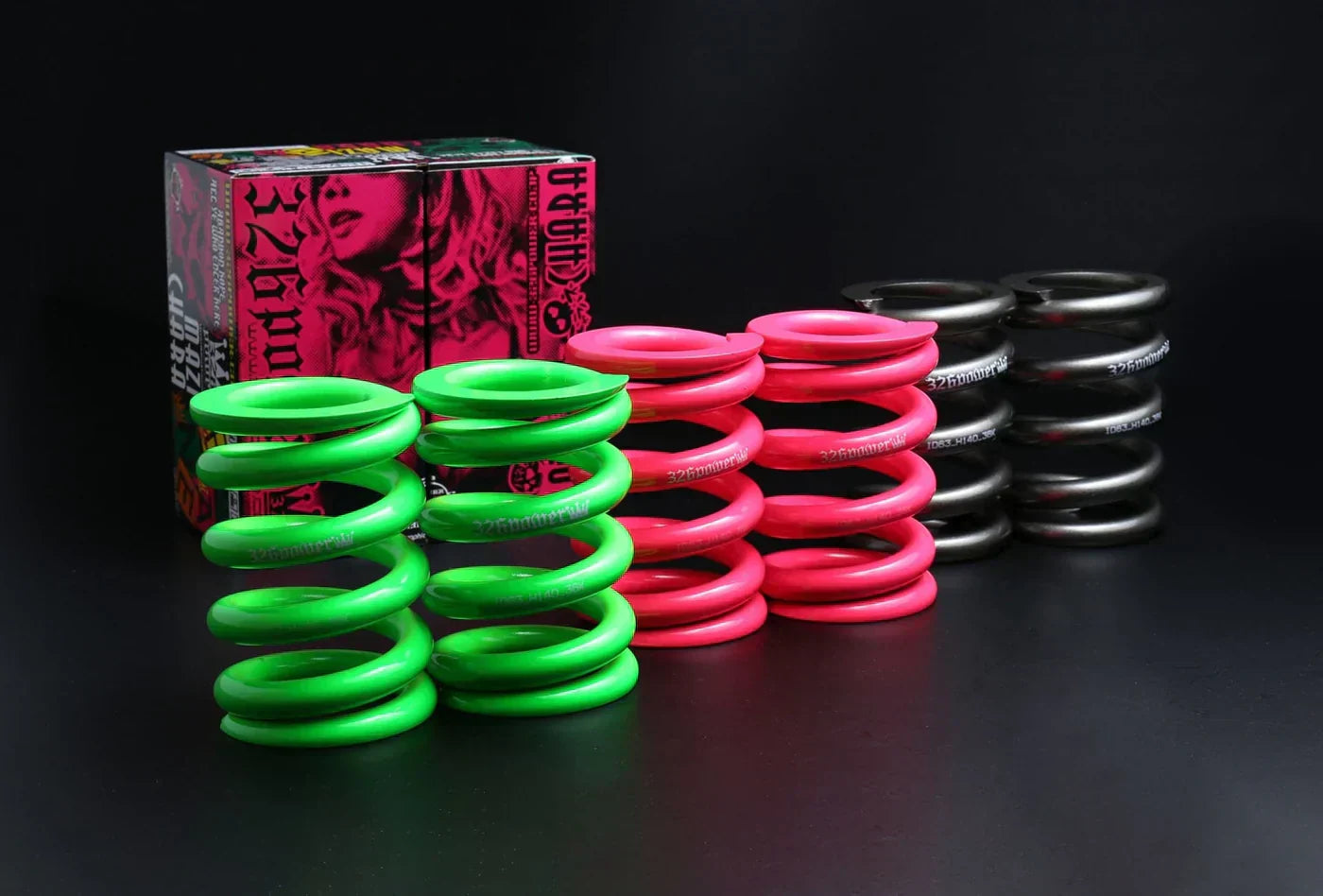
Choosing spring rates is one of the most important decisions you’ll make when upgrading your suspension. Spring rate (measured in kg/mm or lb/in) determines how much force is required to compress the spring a given distance. It directly affects comfort, body control, grip, and how predictable your car feels at the limit. The good news: the coilover kits sold at Springrates are shipped with carefully tested default rates that suit most drivers and platforms. In many cases, sticking with the manufacturer’s included rates is the smartest and most balanced approach. New to adjustable suspension? See what adjustable coilovers offer.
What Is a Spring Rate?
Spring rate is the amount of force required to compress a spring by a unit of distance. In metric, an 8 kg/mm spring requires 8 kg of force to compress 1 mm; in imperial, a 448 lb/in spring requires 448 lb to compress 1 in. You’ll see two common types:
- Linear springs: The rate stays constant through the stroke (preferred for predictability and consistency).
- Progressive springs: The rate increases as the spring compresses, often used to balance comfort and support.
How Spring Rate Changes Ride & Handling
- Ride comfort: Softer rates absorb bumps more easily, while stiffer rates transmit more road feel to the cabin.
- Body control: Stiffer rates reduce roll, squat, and dive for a tighter, more responsive feel.
- Mechanical grip: Too soft and you may bottom out; too stiff and the tires can skip over uneven surfaces. The ideal rate depends on chassis weight, geometry, tire compound, and intended use.
- Damping balance: Springs and dampers must complement each other. Changing one without the other can negatively impact performance. It also shapes the trade-off between ride height and handling.
Why Default Spring Rates on Quality Kits Usually Work Best
Brands like BC Racing, Riaction, Silvers, and Fortune Auto carefully validate each application to target a balanced, real-world setup. Their included spring rates are tuned to match damper valving, tire grip levels, and each chassis’s natural frequency. For most enthusiasts—daily drivers, canyon carvers, or occasional track participants—these defaults provide the best starting point.
| Brand / Series | Default Rate Philosophy | Best For | Common Upgrade Path |
| BC Racing BR Series | Balanced street-first tuning with weekend track capability | Daily + spirited driving | Swift spring upgrade for improved response |
| Riaction GT1 | Linear, predictable rates matched to 32-level damping | Street, canyon, occasional track | Custom spring swap for added stiffness or comfort |
| Silvers NEOMAX | Track-ready street tuning with excellent body control | Spirited street + HPDE | Swift or custom-rate upgrade |
| Fortune Auto (various) | Chassis-specific rates with rebuildable/retunable dampers | Street to time attack | Custom valving and spring pairing |
Note: There’s no one-size-fits-all formula. The right spring rate varies greatly depending on the vehicle platform, weight, suspension design, and driver preference. Comfort is subjective—what feels “too stiff” to one driver may feel “perfect” to another.
When It Makes Sense to Change Spring Rates
- Added weight or aero: Heavy modifications such as big brakes, larger wheels, or aero components can warrant a stiffer spring to maintain support and travel.
- Track or drift use: Drivers who participate in track days or competitive drift events often prefer custom spring setups tuned for their driving style.
- Comfort tuning: Softer springs may help on rough roads, but this can reduce feedback and control. It’s a matter of personal tolerance and preference.
- Ride height extremes: Extremely low setups reduce suspension travel; higher rates may help prevent bottoming out.
Swift Spring Upgrades: A Smart Performance Option
Many coilover kits on Springrates.com can be upgraded with Swift springs. Swift’s proprietary materials and unique winding reduce unsprung weight and friction, offering better response and ride quality without increasing stiffness. It’s a subtle but effective refinement for those seeking sharper feedback or more consistent performance under load.
How to Think About Custom Rates
Customizing spring rates can be rewarding for experienced enthusiasts who understand how it influences the entire suspension system. Factors to consider include:
- Vehicle mass & balance: Front/rear weight bias determines relative stiffness per axle.
- Motion ratio: Suspension geometry affects how spring rate translates to wheel rate—two cars with the same rate can feel completely different.
- Damping control: A spring change may require revalved dampers or adjustable settings to maintain composure. Spring rate works hand in hand with adjusting coilovers for damping and preload.
- Tire grip and road conditions: Smooth tracks can handle firmer setups, while uneven streets benefit from softer rates.
Springrates can provide general guidance or product information, but we encourage customers to choose spring rates based on their personal goals and comfort preferences. Ride quality is highly subjective and varies from driver to driver—what feels ideal for one setup may not suit another. We recommend using the manufacturer’s tested defaults as your baseline, then adjusting at your own discretion.
Practical Path We Recommend
- Select a quality coilover kit designed for your specific chassis and driving goals.
- Start with the included spring rates and ensure proper ride height and alignment.
- Test and evaluate how the car feels over time in real-world conditions.
- If desired, explore Swift or custom spring options to fine-tune performance and comfort.
Frequently Asked Questions
Do I need custom rates for daily driving?
Usually not. The default rates included with most quality coilover kits provide a solid balance between comfort and control for everyday use. Only consider changes if you have a specific reason or personal preference.
Are kg/mm and lb/in interchangeable?
They represent the same concept in different units. You can convert between them (1 kg/mm ≈ 55.9 lb/in), but the “wheel rate” depends on your suspension geometry, not just the spring’s rating.
Will stiffer springs automatically make my car faster?
Not necessarily. Stiffer springs can reduce body roll and improve steering response, but they can also reduce traction on rough roads. The fastest setup is one that maximizes tire contact and stability—balance is key.
Can Springrates tell me which rate is best?
We can offer general information and product insight, but the final decision should be based on your personal preference and intended use. Ride comfort and feel are subjective, so customization is best done at your own discretion.
Ultimately, spring rate selection is about balance—not extremes. Start with a trusted baseline, take notes on how your car behaves, and adjust gradually as you refine your setup. Every driver is different, and that’s part of what makes tuning suspension so rewarding.
Share:
Ride Height vs. Handling: Getting the Balance Right with Coilovers
Are Coilovers Worth It? Pros, Cons, and Who Should Actually Buy Them