
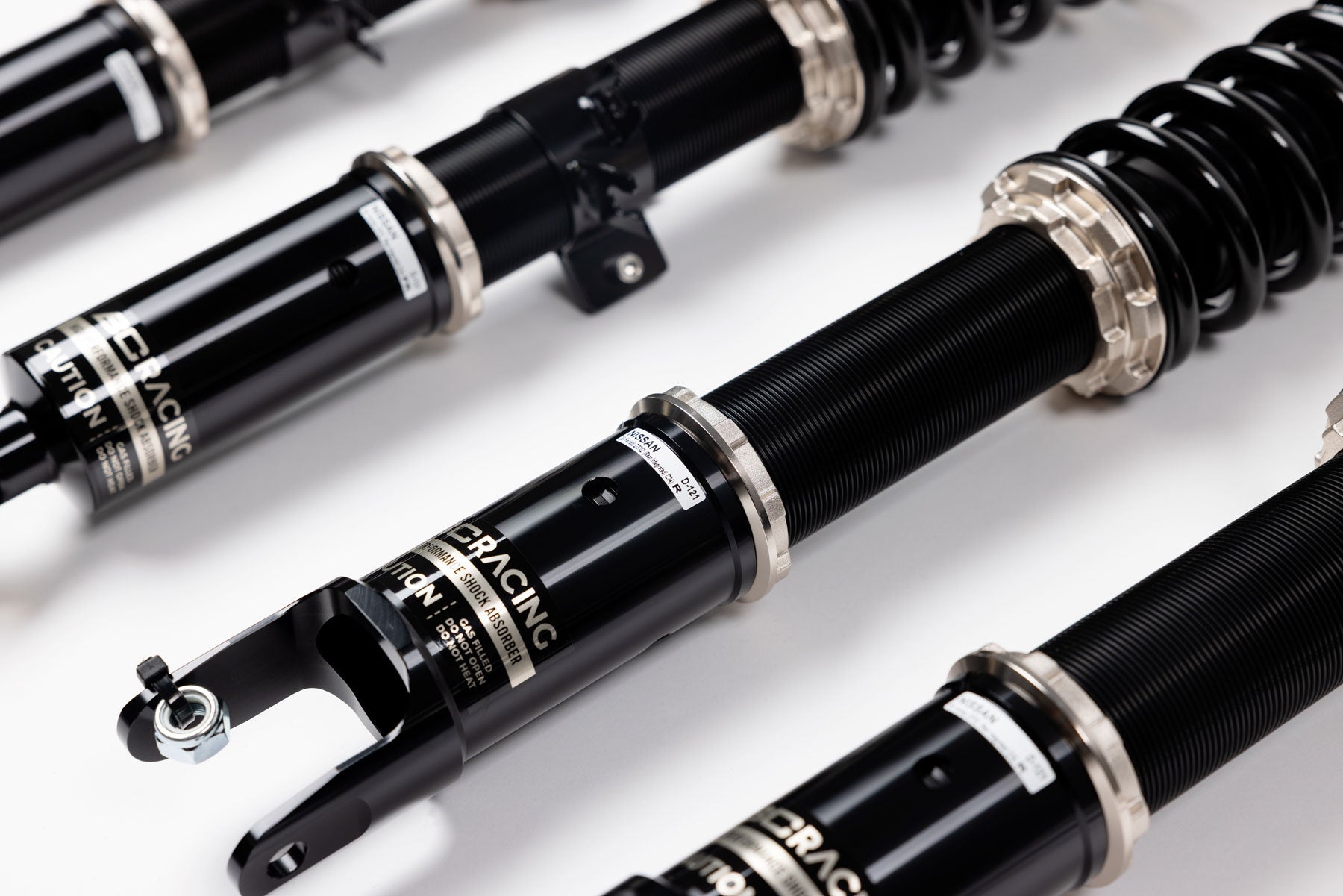
If you have ever looked at a BC Racing coilover part number such as C-165-BR-RA and wondered what all of the letters and numbers mean, there is actually a fairly simple system behind it.
BC Racing part numbers identify the vehicle application, coilover series, and—in many cases—the type of upper mounts included with the kit. Understanding the code can make it much easier to compare BC Racing coilovers and confirm that you are ordering the correct setup for your vehicle.
In this guide, we will break down each section of a BC Racing part number, explain common codes such as BR, DS, RA, RS, and Extreme Low, and walk through a few real-world examples.
Understanding the BC Racing Part Number Format
A typical BC Racing part number can contain up to four main sections separated by hyphens.
Example:
C-165-BR-RA
Reading the part number from left to right:
- C = Vehicle manufacturer or chassis-family prefix
- 165 = Vehicle application number
- BR = BC Racing coilover series
- RA = Top mount configuration
The first two sections identify the vehicle application, while the remaining sections identify the specific version of the coilover kit.
1. The Vehicle Manufacturer Prefix
The first portion of a BC Racing part number is a letter—or occasionally a combination of letters—used to identify a manufacturer or vehicle family.
For example:
- A = Honda / Acura family
- C = Toyota family
- D = Nissan / Infiniti / Datsun family
- I = BMW family
You do not need to memorize these prefixes. They are primarily part of BC Racing's internal cataloging system.
It is also important to understand that the prefix can sometimes follow the underlying chassis rather than the badge on the vehicle. Vehicles that share a platform may therefore appear under the same manufacturer family even if they were sold under different brands.
The Toyota 86, Scion FR-S, and Subaru BRZ are a good example. Although they wear different badges, the vehicles share the same basic platform, so suspension cataloging does not always follow the name on the trunk.
2. The BC Racing Application Number
The number immediately following the manufacturer prefix identifies a specific vehicle application.
In the example:
C-165-BR-RA
165 is the application number.
This number is simply a catalog identifier. It does not indicate:
- Model year
- Vehicle generation
- Spring rate
- Ride height
- Coilover quality
- Performance level
A higher application number does not necessarily mean the vehicle is newer.
For example, BC Racing's C-15 application is used for the 1993-1998 Toyota Supra, while C-169 is used for an older 1982-1986 Supra application.
Think of this number as an application ID rather than a specification.
What Does the “E” Mean in a BC Racing Part Number?
Some BC Racing application numbers have an E immediately after the number.
For example:
A-153-BR-RA
Standard configuration
A-153E-BR-RA
Extreme Low configuration
The E indicates that the coilover kit is built in BC Racing's Extreme Low configuration.
Extreme Low kits are designed to provide additional lowering capability compared with the standard version of the same coilover kit.
Not every BC Racing application is available in Extreme Low, and the amount of additional lowering varies by vehicle.
If your goal is an especially low ride height, it is important to select the Extreme Low version when one is available rather than assuming the standard kit can achieve the same range.
3. BC Racing Coilover Series Codes
The third section of the part number identifies the BC Racing coilover series.
This is one of the most important parts of the SKU because the series determines the basic damper design and performance characteristics of the coilover.
| Code | BC Racing Series |
|---|---|
| BR | BR Series |
| DS | DS Series |
| RM | RM Series |
| ER | ER Series |
| HM | HM Series |
| ZR | ZR Series |
| ZX | ZX Series |
The BR Series is BC Racing's most popular coilover platform and is available for the widest range of vehicles. Other series use progressively more specialized damper designs intended for enthusiasts who want different handling characteristics, additional adjustment, or more track-focused performance.
Not every BC Racing series is available for every vehicle. A particular chassis may be offered in BR and DS, for example, while more specialized ER, HM, ZR, or ZX versions may not be produced for that application.
If you are trying to decide which series is right for your vehicle, see our BC Racing coilover series comparison for a more detailed explanation of the differences between the available damper designs.
4. BC Racing Top Mount Codes Explained
On many BC Racing BR, DS, and RM Series coilovers, the final portion of the part number describes the upper mount configuration included with the kit.
This is especially important because two coilover kits that fit the same vehicle can have different upper mount configurations.
| Code | Front Top Mount | Rear Top Mount |
|---|---|---|
| RS / DS | Rubber | Rubber or factory mount |
| RA / DA / MA | Pillowball or camber plate | Rubber or factory mount |
| RH / DH / MH | Pillowball or camber plate | Pillowball or camber plate |
| RN / DN | Rubber or factory mount | Rubber or factory mount |
The first letter generally corresponds with the coilover series, while the second letter describes the mount configuration.
For example, RA is a BR Series mount code, while DA represents the comparable mount configuration on a DS Series kit.
The RM Series uses MA and MH configurations where applicable.
Pillowball Mount vs. Camber Plate
A listing that states pillowball or camber plate does not necessarily mean you can choose between the two.
The exact hardware is determined by the suspension design of the specific vehicle.
Some vehicles allow BC Racing to incorporate an adjustable camber plate into the upper mount. Other suspension designs may use a pillowball mount without providing camber adjustment at the top of the strut.
Similarly, some applications reuse the factory upper mount instead of including a replacement mount in the box.
If front camber adjustment is specifically important to your build, always verify that the coilover kit for your exact application includes an adjustable camber plate before ordering.
Do All BC Racing Part Numbers Have a Top Mount Code?
No.
Some of BC Racing's more specialized coilover series do not use the same final mount suffix found on BR, DS, and RM Series kits.
ER, HM, ZR, and ZX Series coilovers generally include pillowball or camber upper mounts where applicable, so their part numbers may simply end with the series designation.
For example:
D-30-ER
This part number identifies a Nissan 370Z application using BC Racing's ER Series.
You may also occasionally encounter an additional segment after the normal mount code. These uncommon suffixes can identify something specific to a particular chassis or coilover configuration. If you encounter an unfamiliar suffix, it is best to verify the exact kit specifications rather than assuming what the code means.
BC Racing Part Number Example: C-165-BR-RA
Now we can decode the original example:
C-165-BR-RA
- C = Toyota vehicle family
- 165 = 2020+ Toyota GR Supra application
- BR = BC Racing BR Series
- RA = Pillowball or camber-style front upper mount with a rubber or factory-style rear mount configuration
Put together, the number identifies a BR Series BC Racing coilover kit for the Toyota GR Supra with the corresponding RA upper mount configuration.
BC Racing Part Number Example: C-165-DS-DA
Now compare that with:
C-165-DS-DA
- C = Toyota vehicle family
- 165 = Toyota GR Supra application
- DS = BC Racing DS Series
- DA = Pillowball or camber-style front upper mount with a rubber or factory-style rear mount configuration
Notice that the first two sections are identical to the previous example because both kits fit the same vehicle.
The difference is the coilover series and corresponding mount code.
C-165-BR-RA and C-165-DS-DA therefore fit the same vehicle, but they are not the same coilover kit.
BC Racing Part Number Example: D-30-BR-RS
Here is another example:
D-30-BR-RS
- D = Nissan vehicle family
- 30 = 2009-2020 Nissan 370Z application
- BR = BC Racing BR Series
- RS = Rubber front upper mount with a rubber or factory-style rear mount configuration
Again, once you understand the format, the part number becomes much easier to read.
Why Can Two BC Racing Kits for the Same Car Have Different Part Numbers?
This is one of the most common sources of confusion when shopping for BC Racing coilovers.
The vehicle application is only one part of the SKU.
A single vehicle may be available with multiple BC Racing coilover series, different upper mount configurations, and sometimes standard or Extreme Low ride-height options.
For example:
C-165-BR-RA
and
C-165-DS-DA
Both identify coilovers for the same Toyota GR Supra application, but one uses the BR Series damper and the other uses the DS Series damper.
They can therefore have different damping characteristics, construction, pricing, and intended use even though both physically fit the same vehicle.
Do BC Racing Part Numbers Show the Spring Rate?
No. The normal BC Racing part number does not tell you the spring rate included with the coilover kit.
Spring rates are separate specifications associated with the individual vehicle application and coilover configuration.
Depending on the application, BC Racing coilovers may also be available with custom spring rates or upgraded springs. That does not necessarily change the basic vehicle application portion of the BC Racing part number.
If you are comparing kits, do not assume that two coilovers with similar-looking part numbers use the same spring rates.
What Is the Difference Between Standard and Extreme Low BC Racing Coilovers?
The primary difference is the available ride-height range.
Standard BC Racing coilovers are designed to provide substantial height adjustment for typical street and performance applications.
Extreme Low versions use a configuration intended to provide additional lowering capability for vehicles where a more aggressive drop is desired.
Extreme Low is identified by an E attached to the vehicle application number.
For example:
- A-153-BR-RA = Standard
- A-153E-BR-RA = Extreme Low
Extreme Low should not automatically be considered the better choice. The appropriate version depends on your desired ride height, wheel and tire setup, available suspension travel, road conditions, and intended use.
A Note About ZX and ZR Codes
BC Racing's catalog includes a few codes that can have different meanings depending on where they appear in the part number.
ZX and ZR are examples.
When they appear at the beginning of a part number, they can be vehicle/manufacturer prefixes. When they appear after the application number, they identify BC Racing coilover series.
Position within the part number determines the meaning.
For example:
ZX-05-BR-RS
Here, ZX is part of the vehicle application.
But:
D-30-ZX
Here, ZX identifies the BC Racing ZX Series.
This is why the entire part number should be read in order instead of interpreting individual letters by themselves.
How to Find the Correct BC Racing Part Number for Your Car
Although understanding the BC Racing numbering system is useful, you should not have to decode the catalog manually just to buy coilovers.
The best approach is to begin with your exact vehicle information:
- Year
- Make
- Model
- Chassis or generation
- Trim level when applicable
- Drivetrain when applicable
From there, you can determine which BC Racing applications and series are available for the vehicle.
After confirming fitment, choose the coilover series based on your goals, followed by the appropriate ride-height and mount configuration.
This is particularly important on vehicles where different trims, drivetrains, suspension packages, or model years use different suspension components.
Which BC Racing Series Should You Choose?
Decoding the part number tells you what the kit is, but choosing the correct BC Racing series depends on how the vehicle will be used.
The BR Series is the most common starting point for street cars, daily drivers, and enthusiast builds. Other BC Racing series offer different damper technologies and additional performance capability for more specialized applications.
Rather than choosing a series simply because it is more expensive, consider your vehicle, driving environment, desired ride quality, adjustment needs, and intended use.
For a complete breakdown, read our BC Racing BR vs. DS vs. ER vs. HM Series comparison.
Frequently Asked Questions About BC Racing Part Numbers
What does RA mean on BC Racing coilovers?
RA is a mount configuration used on BR Series coilovers. It generally indicates a pillowball or camber-style front upper mount combined with a rubber or factory-style rear upper mount configuration. The exact hardware depends on the vehicle.
What does RS mean on BC Racing coilovers?
RS generally identifies a BR Series kit using a rubber front upper mount and either a rubber rear upper mount or the vehicle's factory rear mount, depending on the application.
What does DA mean on BC Racing coilovers?
DA is the DS Series equivalent of the RA mount configuration. It generally uses a pillowball or camber-style front upper mount with a rubber or factory-style rear mount.
What does the E mean in a BC Racing part number?
An E immediately following the vehicle application number indicates an Extreme Low BC Racing configuration. Extreme Low versions are designed to provide additional lowering capability compared with the standard version of the same application.
Does a BC Racing part number tell you the spring rate?
No. The standard BC Racing part number identifies the vehicle application, coilover series, and applicable mount configuration. Spring rates are listed separately.
Can two different BC Racing part numbers fit the same vehicle?
Yes. The same vehicle may have several different BC Racing part numbers because it may be available in multiple coilover series, mount configurations, or ride-height configurations.
Do BC Racing coilovers always include camber plates?
No. Camber plates are only included on applications where the vehicle's suspension design allows BC Racing to incorporate them. Some vehicles use pillowball mounts without camber adjustment, rubber mounts, or reuse the factory upper mounts.
How do I know which BC Racing coilovers fit my vehicle?
Always search using your exact year, make, model, chassis, trim, and drivetrain when applicable. Vehicle fitment should be confirmed before choosing the BC Racing series or optional configuration.
Shop BC Racing Coilovers at Springrates
Understanding a BC Racing part number makes comparing coilovers much easier, but choosing the correct kit ultimately comes down to matching the right vehicle application with the right damper series and configuration.
Springrates carries a wide selection of BC Racing coilovers for street, performance, track, and custom suspension builds.
Use our vehicle fitment tools to find BC Racing coilovers made specifically for your car, or contact our suspension specialists if you need help confirming a part number, mount configuration, spring rate, or Extreme Low application before ordering.
Find the right BC Racing coilovers for your vehicle and build your suspension setup with confidence.
Share:
Best Coilovers for Daily Driving in 2026
Universal Air Suspension Joins the Air Lift Family