
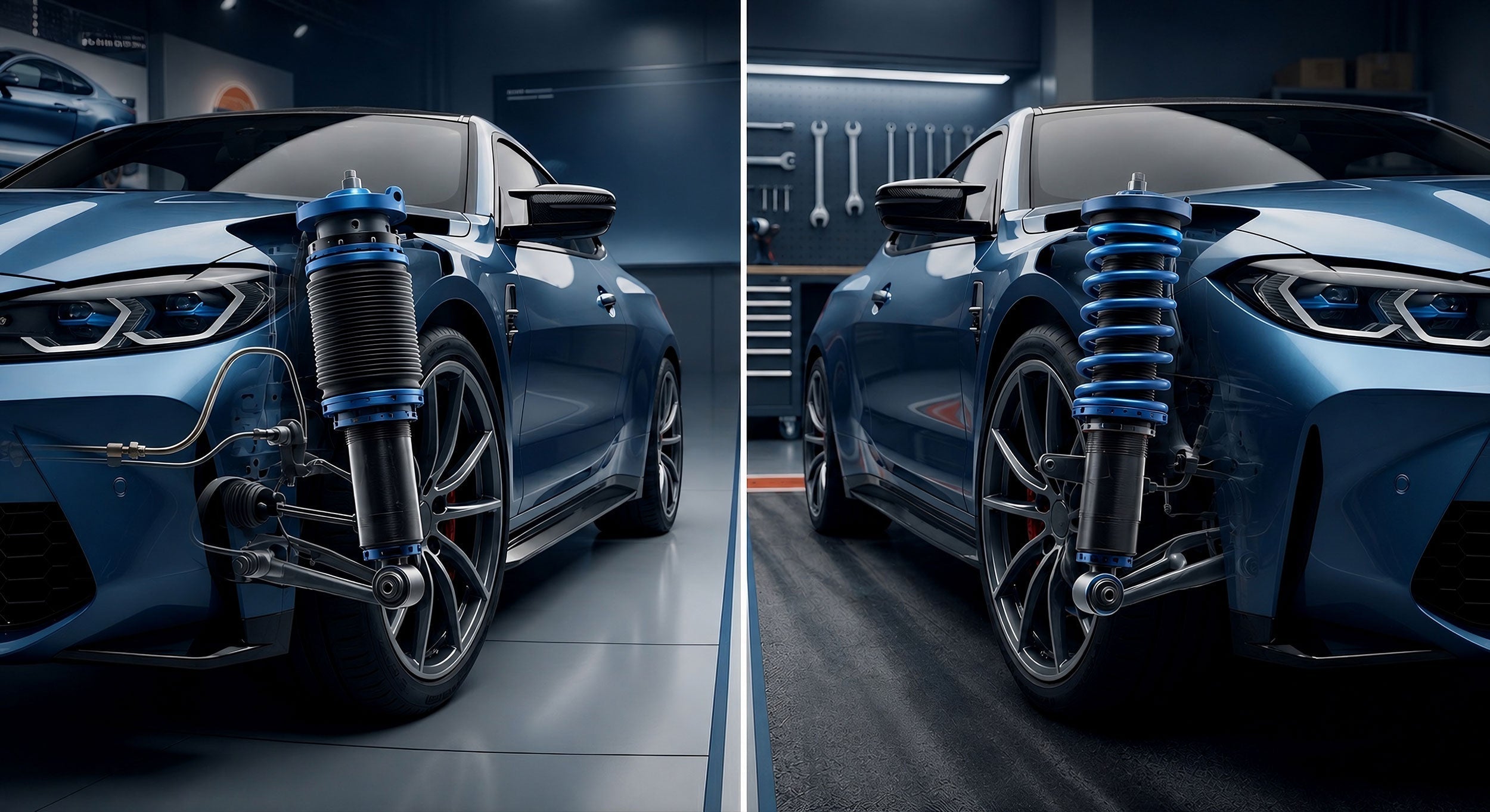
If you’re shopping for a suspension upgrade, one question comes up again and again: is air suspension better than coilovers? It’s a fair question, because both can completely change how your car looks and drives—but they’re built around very different priorities.
Springrates has specialized in aftermarket suspension since 2005, and we sell both. We love a clean air-ride build as much as anyone—but for most enthusiasts, a quality set of coilovers delivers more performance for the money. This guide lays out the honest pros and cons of each, so you can match the right setup to your car, your goals, and your budget.
The Short Answer
Neither one is universally “better”—they win in different areas.
- Choose air suspension if you want ride height you can adjust on the fly, the plushest possible cruising comfort, extra clearance for steep driveways, and a slammed show stance you can raise up to drive.
- Choose coilovers if you want the sharpest handling, the best performance per dollar, lighter weight, fewer things to go wrong, and a setup you can take to the track.
For most street and performance drivers, coilovers are the better all-around value. Air suspension shines for show builds, stance, and drivers who put ride comfort and adjustability ahead of outright handling.
How Air Suspension Works
Air suspension—often called “air ride” or “bags”—replaces your coil springs with air springs. An onboard compressor fills an air tank, and a management system inflates or deflates each corner to raise or lower the car. With the push of a button or a tap on your phone, you can lift the car to clear a driveway and drop it to the ground when you park.
A complete air suspension system typically includes air struts or bags, a compressor, an air tank, a management/controller unit, valves, and air lines. That’s a lot of components working together—which is exactly where both its strengths and its weaknesses come from.
How Coilovers Work
A coilover combines a shock absorber and a coil spring into one adjustable assembly. Most modern coilover kits let you set ride height with a threaded body and adjust damping (how firm or soft the suspension feels), and many add camber plates for alignment tuning.
Once installed, a coilover is a mostly mechanical, self-contained system. You set your height and damping with hand tools, get an alignment, and drive—no compressor, tank, or wiring to manage. That keeps coilovers simple, light, and dependable. And if you want the ability to lift the nose over driveways and speed bumps, you can pair most coilovers with an air cup kit for push-button front lift—more on that below.
Air Suspension vs Coilovers: Side-by-Side Comparison
| Factor | Air Suspension | Coilovers |
|---|---|---|
| Ride Height Adjustment | On the fly, at the push of a button | Manual with a spanner wrench (add air cups for push-button nose lift) |
| Adjustment Range | Very large (slammed to fully driveable) | Moderate (typically a 1–4 in. drop) |
| Cruising Comfort | Excellent and plush | Firm to moderate (kit-dependent) |
| Handling Precision | Good on high-end kits | Excellent |
| Track / Autocross | Not ideal | Recommended |
| Typical Parts Cost | $2,500–$6,000+ | $800–$3,000+ |
| Installation | Complex (struts, lines, tank, compressor, wiring) | Moderate (bolt-in) |
| Added Weight | 40–80+ lbs (tank, compressor, management) | Minimal |
| Potential Failure Points | More (bags, lines, compressor, solenoids) | Fewer |
| Maintenance | Drain tank, check for leaks | Periodic inspection, occasional rebuild |
| Best For | Show, stance, clearance, plush daily driving | Performance, handling, value, track |
Air Suspension: Pros and Cons
Where Air Suspension Wins
- Ride height on demand—drop it low when parked, raise it to clear driveways, speed bumps, and ramps
- Exceptional ride comfort when aired up, thanks to the large air volume in each spring
- The most aggressive, laid-out show stance, with the ability to raise the car back up to actually drive it
- Easy to fine-tune height for different wheel and tire setups
The Trade-Offs
- Higher total cost once you add management, a compressor, and installation
- More components means more potential points of failure (leaks, compressor wear, solenoids)
- Added weight from the tank, compressor, and lines
- Generally not the choice for serious track or autocross use
- More involved installation, plus occasional upkeep like draining moisture from the tank
Coilovers: Pros and Cons
Where Coilovers Win
- The best handling and body control, especially during spirited or track driving
- More performance per dollar than a comparable air setup
- Lighter weight, with no compressor, tank, or management to carry around
- A simple, dependable, mechanical design with fewer things to fail
- Adjustable damping on most kits to balance comfort and performance
The Trade-Offs
- Ride height is set manually—though an air cup kit adds push-button front lift
- Firmer than air at cruise, though a quality street kit is very livable day to day
- Less ground clearance once lowered—again, air cups solve this for driveways and ramps
- Proper setup—height, preload, damping, and alignment—matters to get the best results
Best of Both Worlds: Add Air Cups to Your Coilovers
Here’s something many drivers don’t realize: the on-the-fly lift that makes air suspension so convenient isn’t exclusive to air. You can add an air cup lift kit to most coilovers and raise the front of the car at the push of a button—just enough to clear steep driveways, speed bumps, and parking ramps—then settle right back to your set ride height.
Kits like Stanceparts and D2 Racing VERA install between the spring and the coilover’s top mount, using a small compressor and tank to add temporary lift on demand. You keep the precise handling and value of coilovers while gaining the clearance convenience that used to require a full air-ride system.
It’s the same idea automakers now build in from the factory. Many modern sports and exotic cars—from Porsche and Lamborghini to Corvette and McLaren—come with a factory front-axle lift that raises the nose to clear obstacles, then lowers it for performance. Air cups bring that capability to almost any coilover-equipped build.
Ride Quality: Which Is More Comfortable?
When aired up, air suspension is hard to beat for plush, soak-up-everything comfort—the large air volume in each spring smooths out bumps in a way few coilovers match. That’s a big reason show and stance builds love it.
Coilovers feel firmer because they’re tuned for control rather than float. That said, a well-chosen street coilover with adjustable damping can be perfectly comfortable for daily driving. The difference is one of priorities: air leans toward comfort, while coilovers lean toward the connected, planted feel enthusiasts want when the road gets interesting.
Handling and Performance: Which Is Better?
This is where coilovers pull ahead. A quality coilover is engineered as a matched spring-and-damper system with precise valving, which delivers consistent, predictable handling and excellent body control. That consistency is exactly what you want on a canyon road, an autocross course, or a track day.
High-end air struts have come a long way and can handle respectably on the street, but air’s strength is comfort and adjustability—not lap times. If outright performance is your priority, coilovers remain the clear choice.
Cost: What You’ll Actually Spend
Coilovers are usually the better value. A complete kit runs roughly $800 to $3,000+ depending on the brand and features, and installation is a straightforward bolt-in job.
Air suspension adds up to more. The struts or bags are only part of the equation—you also need a compressor, an air tank, a management system, and the labor to wire and plumb it all. A full build commonly lands between $2,500 and $6,000+ installed. You’re paying for adjustability and comfort, not handling.
Reliability and Maintenance
Coilovers are simple by design. With far fewer components, there’s less to go wrong, and maintenance usually comes down to periodic inspection and the occasional rebuild on higher-end kits.
Air suspension is more complex. Modern systems are reliable when they’re installed correctly and maintained, but air springs can develop leaks over time, compressors wear, and moisture needs to be drained from the tank. More parts simply means more potential points of failure—worth weighing if you want a true set-and-forget setup.
Which Should You Choose?
Choose Coilovers If:
- Handling and performance are your top priority
- You track, autocross, or drive aggressively
- You want the best value for your money
- You prefer a simple, lightweight, dependable setup
- You want a clean drop without the complexity of air management
Choose Air Suspension If:
- You want to adjust ride height on the fly
- Maximum cruising comfort matters most to you
- You’re building a show or stance car and want it laid out
- You need extra clearance for steep driveways or low roads
- You’re willing to spend more and maintain a more complex system
Our Take
Because we sell and support both, our recommendation isn’t tied to moving one product over another. For most enthusiasts—especially anyone who values handling, simplicity, and getting the most out of their budget—coilovers are the better all-around upgrade, and they’re where we carry the deepest selection: from BC Racing, Fortune Auto, and KW to Silvers, Feal, and more.
Air suspension earns its place for show builds, stance, and drivers who put ride comfort and adjustability first. It’s a fantastic technology for the right goals—just a different tool for a different job. The right answer comes down to what you want your car to do.
Frequently Asked Questions
Is air suspension better than coilovers?
It depends on your goals. Air suspension is better for adjustable ride height, cruising comfort, and show stance. Coilovers are better for handling, performance, value, and track use. For most performance-minded drivers, coilovers are the better all-around choice.
Do coilovers ride rougher than air suspension?
Generally, yes—coilovers feel firmer at cruise because they’re tuned for control. That said, a quality street coilover with adjustable damping is comfortable enough for daily driving, while air suspension is at its plushest when aired up.
Is air suspension reliable?
Modern air suspension is reliable when it’s installed correctly and maintained. It does have more potential failure points than coilovers, though—air springs can leak, compressors wear, and the tank needs occasional draining.
Can coilovers raise the car like air suspension?
Not on their own, but you can add an air cup lift kit (such as Stanceparts or D2 Racing VERA) to most coilovers for push-button front lift over driveways and speed bumps. It’s the same concept as the factory front-lift systems found on many modern sports and exotic cars—you keep coilover handling while gaining lift-on-demand clearance.
Can you track a car on air suspension?
You can, and high-end air struts handle better than ever, but coilovers remain the choice for serious track and autocross use because of their precise, consistent damping and body control.
Which is more expensive, air suspension or coilovers?
Air suspension usually costs more overall. Once you add a compressor, tank, management, and installation, a full air build often runs $2,500–$6,000+, while a complete coilover kit typically runs $800–$3,000+.
Can you switch from coilovers to air suspension later?
Yes. Many enthusiasts start on coilovers for performance and convert to air later for a show build, or the other way around. Just plan for the additional components and installation that air requires.
Why Buy Your Suspension from Springrates?
Since 2005, Springrates has been the original suspension source for enthusiasts who want real performance, honest recommendations, and a smooth ordering experience. Whether you land on coilovers or air, we’ll help you match the right setup to your car and your goals the first time—so you don’t waste money replacing parts later.
- Vehicle-specific fitment support
- Honest recommendations based on how you actually use your car
- Real-time inventory updates
- Lowest price guaranteed
- Fast, free shipping on most orders
Ready to Upgrade?
Still not sure which way to go? Reach out and our team will help you choose the right suspension for your specific car and driving style.
Share:
Air Lift ALP4 Upgrade Kit: How to Upgrade Your 3P or 3H to the New Air Management System
Best Coilovers for Daily Driving in 2026